

Building early maths skills through cooking
Cooking offers young children a practical, enjoyable way to meet early mathematical ideas through familiar routines. Measuring flour, counting berries, sharing biscuits and timing a recipe all invite children to use numbers with a clear purpose. With calm guidance, you can turn snack preparation or baking into meaningful early maths practice without making it feel like a formal lesson.
Cooking makes numbers useful and visible
Young children learn best when they can touch, move, compare and talk about objects. A recipe provides all of these opportunities. Instead of seeing numbers only on a worksheet, children discover that quantities affect what they make and eat.
Start with simple tasks that suit the child’s stage of development. You might ask them to place three apple slices in each bowl, count six spoons of yoghurt, or find two cups for a drink. Use number words naturally and allow time for the child to point to or move each item as they count.
One-to-one correspondence is a helpful concept to develop. When a child puts one raisin into each section of a muffin tray, they are matching one object to one space. This supports accurate counting and helps them understand that the final number said represents the total amount.
Cooking also creates opportunities to use mathematical language:
- More and fewer
- Full and empty
- Heavy and light
- First, next and last
- Same and different
- Bigger and smaller
Clear, positive routines can make these learning moments easier for everyone. Strategies from Nurturing positive behaviour in early years classrooms can also support turn-taking, listening and shared responsibility while children cook together.
Measuring ingredients introduces quantity and comparison
Measuring is often the most obvious mathematical element of cooking, but it does not need to begin with scales or exact grams. Young children can first explore capacity through pouring, filling and comparing containers.
Provide safe utensils such as plastic cups, spoons, jugs and bowls. Ask questions that encourage prediction: “Which cup do you think will hold more?” or “How many small spoons will fill this bowl?” Let children test their ideas and observe the results.
When following a recipe, use real measuring tools where possible. A half cup and a full cup allow children to see that parts can make a whole. A teaspoon and tablespoon offer a natural comparison of size. You can say, “We need two small spoons of cinnamon,” then count slowly together.
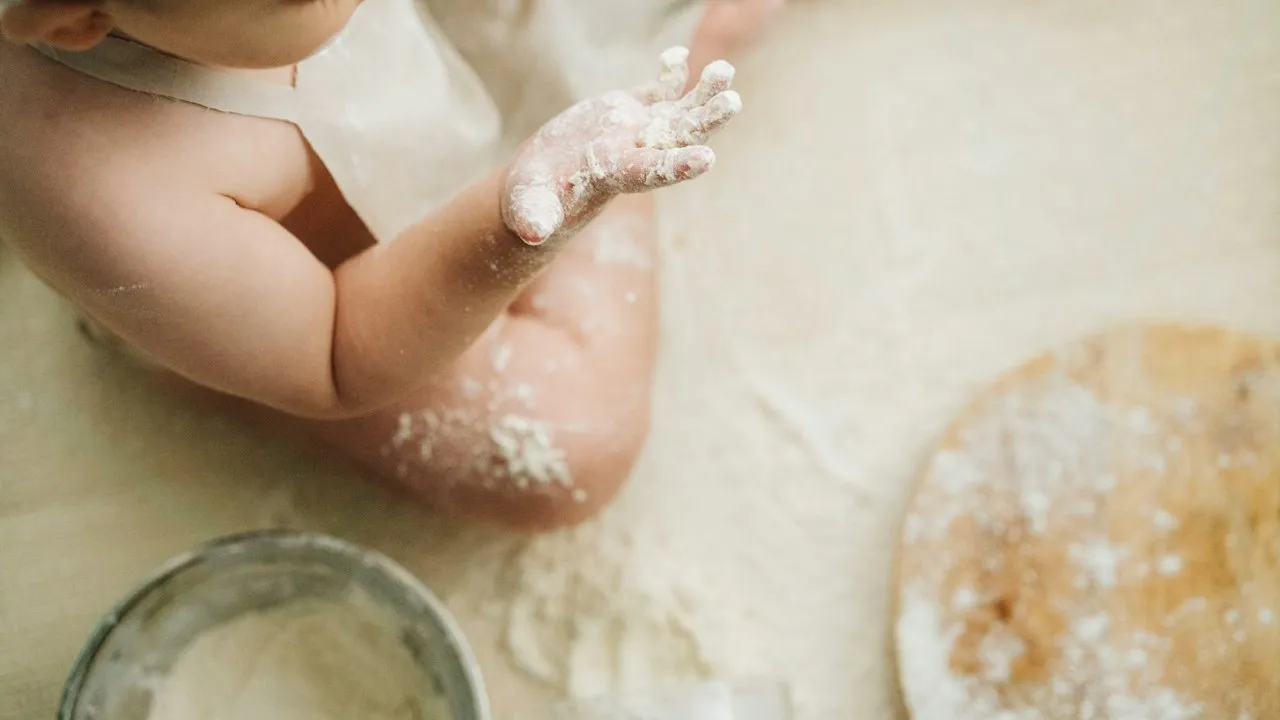
Mess is part of the process, especially with pouring. Set up a tray beneath bowls and use manageable amounts of dry ingredients. This gives children room to practise independently while keeping the activity relaxed.
Simple measuring activities for younger children
For toddlers and nursery-aged children, focus on exploratory language rather than precision. They can scoop oats into a bowl, fill paper cases with cereal, or compare which container feels heavier. You can introduce words such as “nearly full” and “too much” as they work.
For older early years children, invite more careful measuring. They may level a spoon, count scoops, read simple numerals on a measuring jug, or compare the weight of two ingredients on balance scales. These activities build confidence with quantity through direct experience.
Recipes support sequencing, patterns and problem-solving
Mathematics includes more than counting and measuring. Recipes follow a sequence, and children can learn to order actions from beginning to end. Before cooking, place picture cards showing each step on a table: wash hands, collect ingredients, mix, fill the tray, bake, cool and serve. Ask the child to arrange the cards in order.
Patterns can appear in many foods. Children may create alternating fruit skewers with strawberry, banana, strawberry, banana, or decorate crackers with repeating shapes. Start with a simple AB pattern, then invite children to continue it or invent one of their own.
Problem-solving arises naturally when things change. Perhaps there are only four strawberries but five bowls, or the recipe needs eight cupcake cases and the cupboard contains a mixed pile. Encourage children to think aloud before offering the answer. Questions such as “What could we do?” and “How many more do we need?” promote reasoning.
Digital tools can extend planning activities for older children, such as looking at a child-friendly recipe or making a visual shopping list. Before using websites, teach safe habits with guidance from Teaching children safe online research habits. Adult supervision remains appropriate whenever children access online content.
Talk helps children make sense of mathematical ideas
The quality of conversation matters more than completing a recipe perfectly. Use open questions that invite children to notice, estimate and explain. For example:
- “How many pieces do you think are here?”
- “Which bowl has less?”
- “What might happen if we add one more spoon?”
- “How can we share these equally?”
- “What do we need to do before the mixture goes into the oven?”
Give children time to respond. They may use gestures, partial answers or informal words before they can explain their thinking fully. Repeat and extend what they say. If a child says, “This one is big,” you could respond, “Yes, this bowl is bigger, and it holds more mixture.”
Avoid correcting every mistake immediately. If a child counts the same item twice, you might suggest moving each item into a new bowl as it is counted. The aim is to build curiosity and willingness to try again.
Safe kitchen routines protect learning time
Adult supervision is necessary around heat, sharp tools, electrical equipment and food hygiene. Choose tasks that children can complete safely, such as washing produce, tearing lettuce, stirring cold mixtures, using blunt child-safe cutters and arranging ingredients.
Prepare the workspace before inviting children to join you. Place ingredients within reach, keep hot pans away from the activity area and explain simple rules, including handwashing and waiting for an adult before touching the oven. Predictable routines help children focus on both the recipe and the maths.
Cooking also supports patience. Waiting for dough to rise or food to cool introduces a basic sense of time. A timer can make this visible, while a short song or tidy-up task gives children something purposeful to do as they wait.
Cooking can become a regular maths routine
Short, repeated experiences are often more valuable than an occasional complicated baking project. A weekly fruit salad, sandwich-making session or simple no-bake recipe can bring numbers into children’s daily learning in a warm and memorable way.
Key points to carry into your next cooking activity include:
- Count real objects that children can move, share and organise.
- Use measuring tools to explore full, empty, more, less and half.
- Invite children to predict, compare and explain their choices.
- Include patterns, sequencing and equal sharing alongside number work.
- Keep tasks safe, simple and suited to each child’s independence.
By making cooking a shared routine, you give children repeated chances to see mathematics as something useful, social and enjoyable.